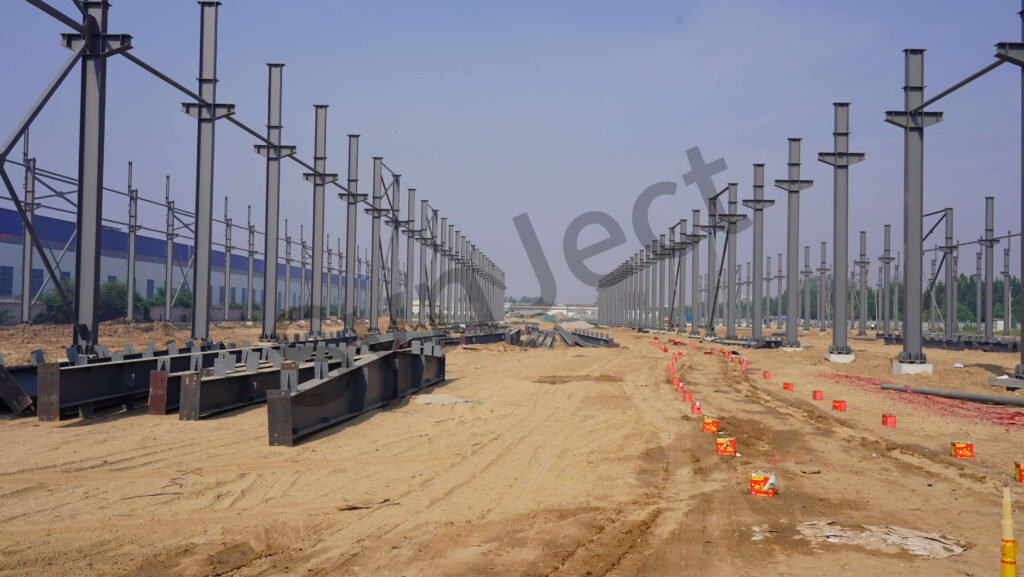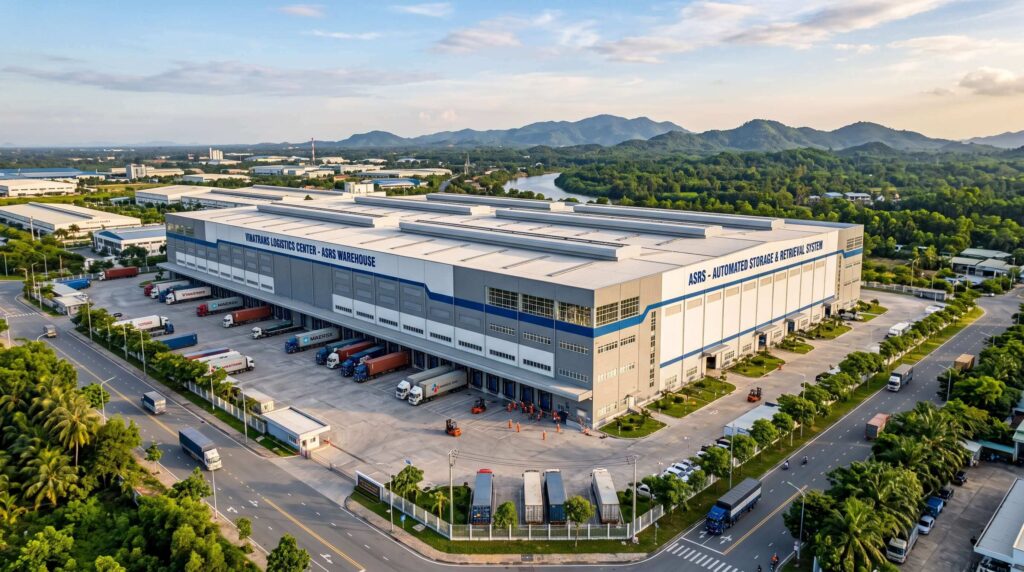
- Execution certification beats management certification. EN 1090-2 sets the execution class, welding coordination and NDT depth. SynJect fabricates to EXC2 under certificate 2787-CPR-01627; ISO 9001 alone never substitutes.
- Seismic design names the zone. RPS 2000 (2011) assigns five zones with peak ground accelerations from 0.04g to 0.18g. Ask for the zone-specific calculation package, not a generic seismic rating.
- NDT records must trace to joints. WPS, PQR, welder qualifications and ISO 3834 coordination sit behind every weld. Sample reports prove the system works.
- Capacity means a booked production slot. An 80,000 m² plant with cranes and dedicated cells delivers when the production plan carries dates. For a 15,000 m² warehouse, our window runs 12-14 weeks.
- Commercials carry the same documentation. Itemised CIF Casablanca quotes under Incoterms 2020 beat lump sums. Published reference: USD 1,575,000 for a 15,000 m² warehouse.
Morocco’s construction pipeline now moves faster than its certified supply base. The country co-hosts the 2030 World Cup with Spain and Portugal. Moreover, the programme adds a stadium and sports infrastructure plan worth MAD 14.5 billion. It sits on top of steady industrial, logistics and agricultural demand.
Against that background, procurement teams evaluating a steel fabricator Morocco contractors can verify face a familiar problem. Quotes arrive at similar prices with very different levels of documentation. However, the price sheet rarely shows the difference.
This guide sets out seven checks. Specifically, each check separates a fabricator who documents execution from one who only claims it. We wrote the guide from the supply side; as a result, we apply the same seven checks to our own plant.
Choosing a Steel Fabricator Morocco Contractors Can Verify
Selection decisions usually fail on documentation, not on steel. A fabricator without certified execution procedures passes the price screen and then stalls at the permit stage. Uncertified welds force rework on site, while unconfirmed capacity turns into missed milestones. In essence, each failure traces back to a check the buyer skipped.
Morocco’s own pipeline shows how the market rewards verification. The Grand Stade Hassan II in El Mansouria will seat 115,000 spectators. Moroccan contractors SGTM and TGCC won the roof and facade package, worth about MAD 3.2 billion. Export fabricators also join programmes of this scale as component suppliers and subcontractors. Therefore, that route rewards the steel fabricator Morocco buyers can audit, not the one with the lowest headline price.
The seven checks follow the order a procurement team meets them. First comes certification, then the seismic basis, welding records, capacity, coatings, commercial terms and erection support.
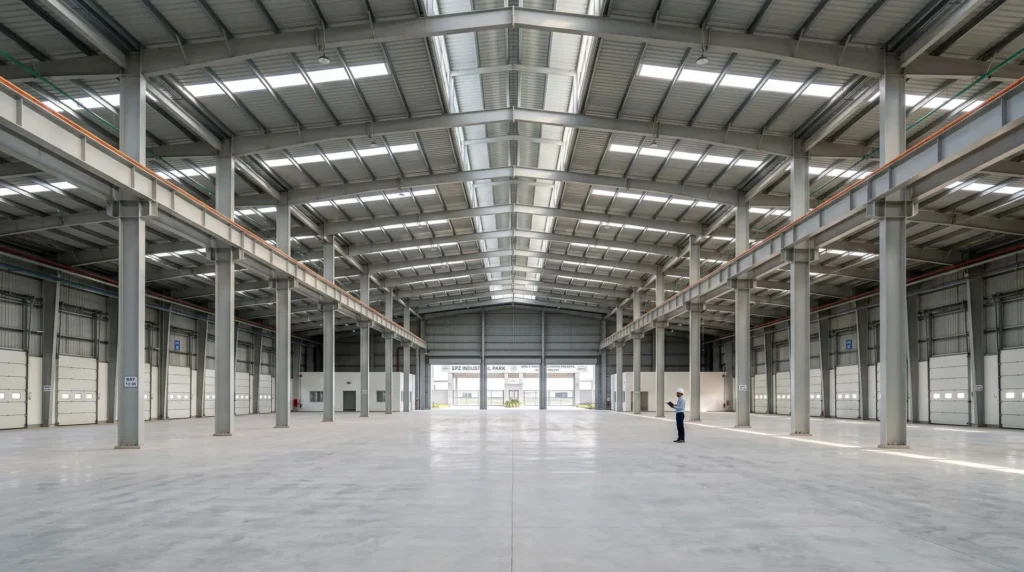
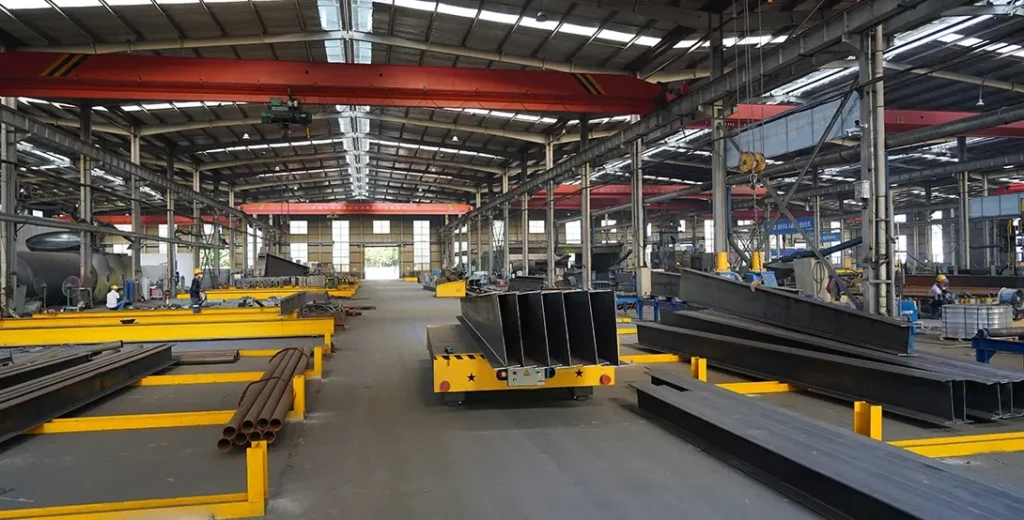
 Multi-bay workshop: H-section assembly lines under overhead cranes, with material bays laid out to keep handling distances short.
Certifications That Match the Execution Scope (Check 1)
Certificates divide into two families. Execution certificates cover the steelwork itself, whereas management certificates cover the factory system. Buyers need both; indeed, the distinction matters.
For steelwork, the reference standard is EN 1090-2, the European standard for the execution of steel structures. Execution classes run EXC1 to EXC4, and the class drives welding coordination, inspection intensity and documentation depth. SynJect fabricates to EXC2 under certificate 2787-CPR-01627. We weld to AWS D1.1 procedures with welders qualified to EN ISO 9606, and we coordinate welding to ISO 3834. In addition, we back the system with ISO 9001 (128224QJ0034R0S), ISO 14001 (128224E0234R0S), ISO 45001 (128224S0217R0S) and CE marking.
However, a factory holding only ISO 9001 cannot execute EN 1090-2 work. Quality management certification says nothing about welding procedures, execution class or nondestructive testing. Ask for the certificate PDFs, the scope statements and the expiry dates, then check the numbers against the issuing body. A steel fabricator Morocco buyers trust publishes numbers, not logos.
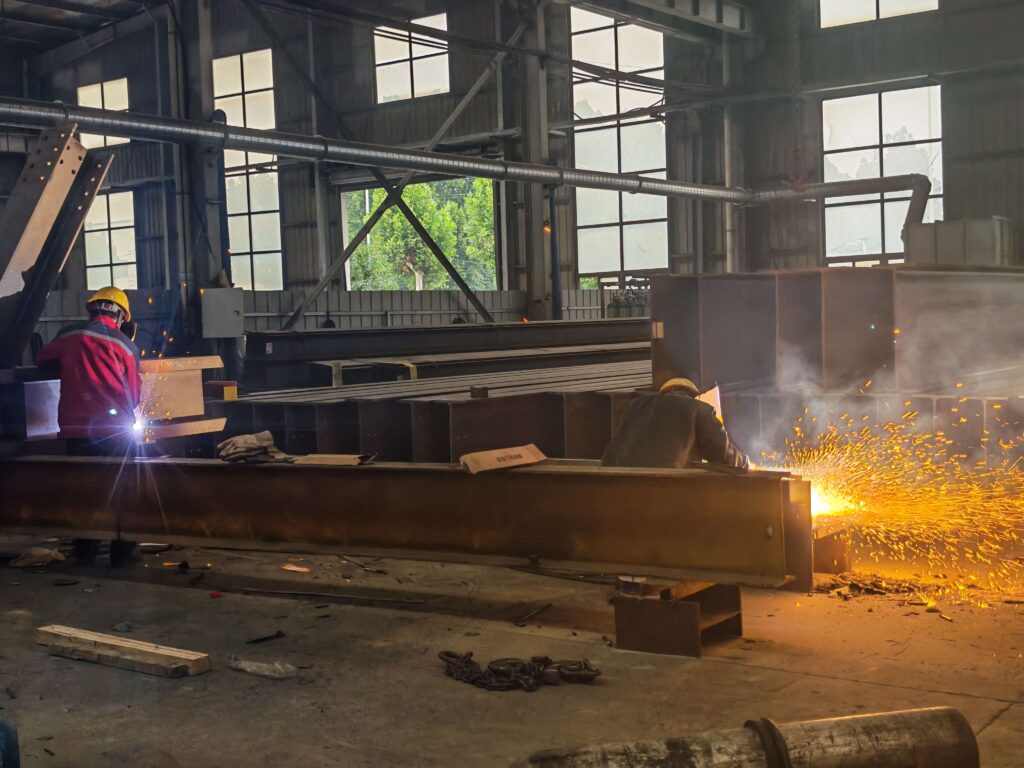
 Submerged-arc welding on an H-section assembly line: continuous, uniform bead with fine regular ripples, no spatter.
Seismic Design to RPS 2000, Not Generic Claims (Check 2)
Morocco’s mandatory seismic regulation is RPS 2000 (2011 version), established by decree n° 2-02-177. The regulation divides the country into five seismic zones. Peak ground accelerations run from 0.04g in zone Z0 to 0.18g in zone Z4, the national maximum. Therefore, no Moroccan zone carries a 0.5g design acceleration.
Treat any single seismic rating as a red flag. The correct question names the site: which zone does the project fall in, and which soil class applies? Ask for the zone-specific calculation package, covering base shear, drift and connection detailing. In other words, a fabricator who cannot produce that package has not done the analysis.
Where a structure falls outside RPS 2000 scope, we design to the Eurocode framework. That means EN 1998 for seismic action, EN 1993 for steel design and EN 1991 for loads. In addition, the European Commission publishes the official reference for these standards (Eurocodes: EN 1990 to EN 1999). In short, a code basis you can verify independently beats a claim you cannot.
Welding and NDT Documentation You Can Audit (Check 3)
Welding quality lives in the records, not in the welder’s word. For each welded joint, a compliant fabricator holds a welding procedure specification (WPS). A procedure qualification record (PQR) supports it. Welders carry current qualifications; in addition, a welding coordinator per ISO 3834-2 owns the system.
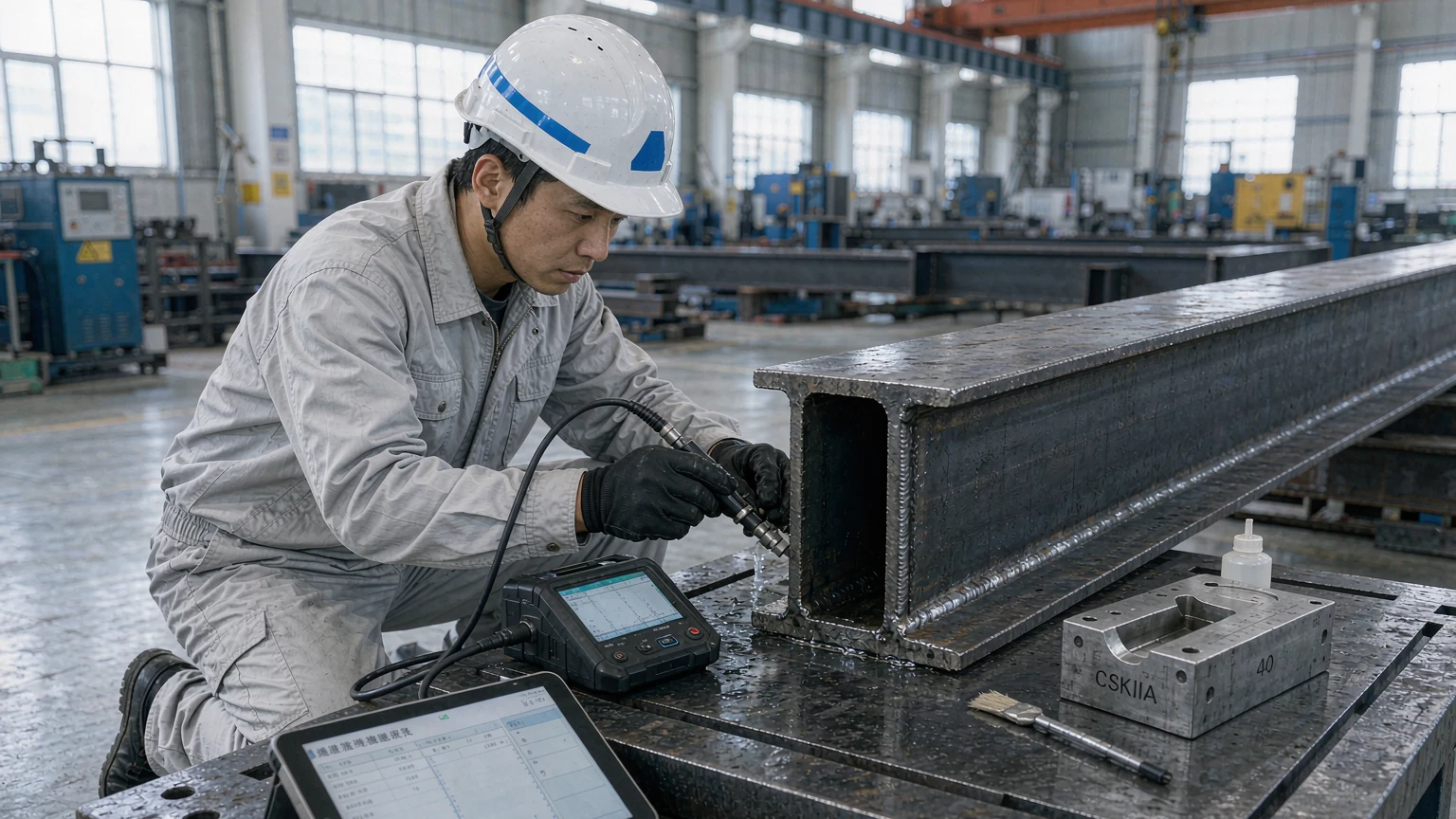
Nondestructive testing closes the loop. Depending on joint type and execution class, we apply ultrasonic, magnetic particle and radiographic testing. Every report traces to a member mark and a joint number. Your inspector can therefore sample any weld and find its record.
Specifically, ask three questions at quotation stage. Which acceptance criteria govern each joint? What NDT methods cover which joint types? Can you supply a sample report from a completed project? A fabricator who answers with documents will deliver them. In contrast, one who answers with adjectives will not.
Capacity, Production Slots and Schedule Commitments (Check 4)
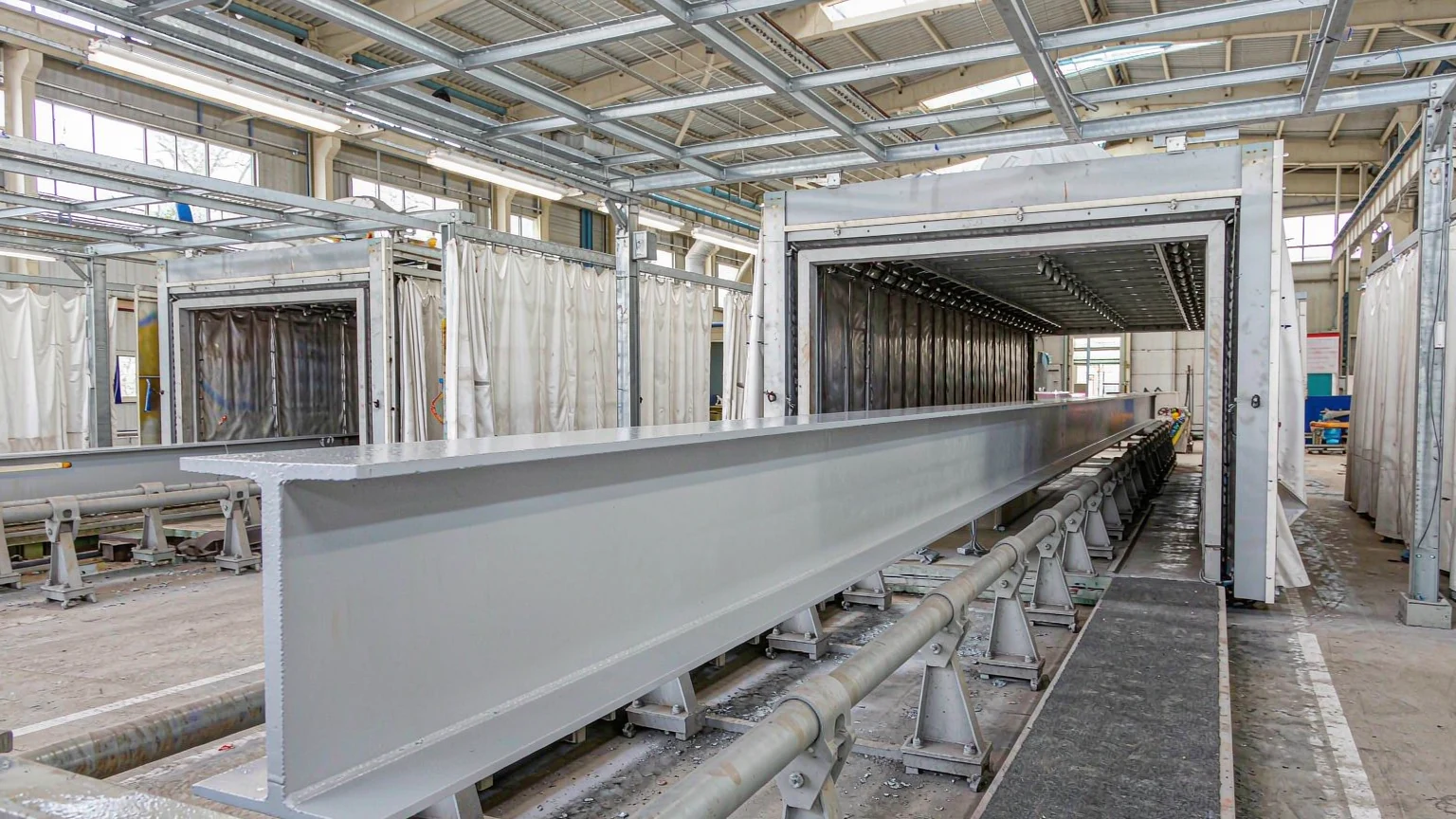
Capacity claims need proof in the schedule, not in the brochure. Our plant covers 80,000 m² across multiple bays. The layout includes overhead cranes, H-section assembly lines, submerged-arc welding stations, flange straighteners, blasting and coating booths. As a result, throughput follows from booked production slots, and slots follow from order confirmation.
In addition, ask for a dated production plan: design freeze, material release, fabrication window, coating, packing and sailing. For a 15,000 m² warehouse, our order-to-assembly window runs 12-14 weeks. The breakdown: six weeks for design and fabrication, three for coating and quality control, three for shipping and two for on-site assembly. Sea transit from Shanghai to Casablanca takes 20-25 days. Larger or longer-span structures scale from that basis, while we confirm the window per project class at enquiry stage.
In effect, the schedule commitment matters more than the plant photograph. A dated plan with weekly output reporting protects your programme. A capacity number without a booked slot protects nothing.
Coatings Specified Against Moroccan Exposure (Check 5)
Coating failures arrive years later, and they arrive silently. Every steel fabricator Morocco buyers shortlist should specify against exposure categories, not against price per tonne. Firstly, we blast clean to ISO 8501-1 Sa 2.5 and select the system against ISO 12944 exposure categories.
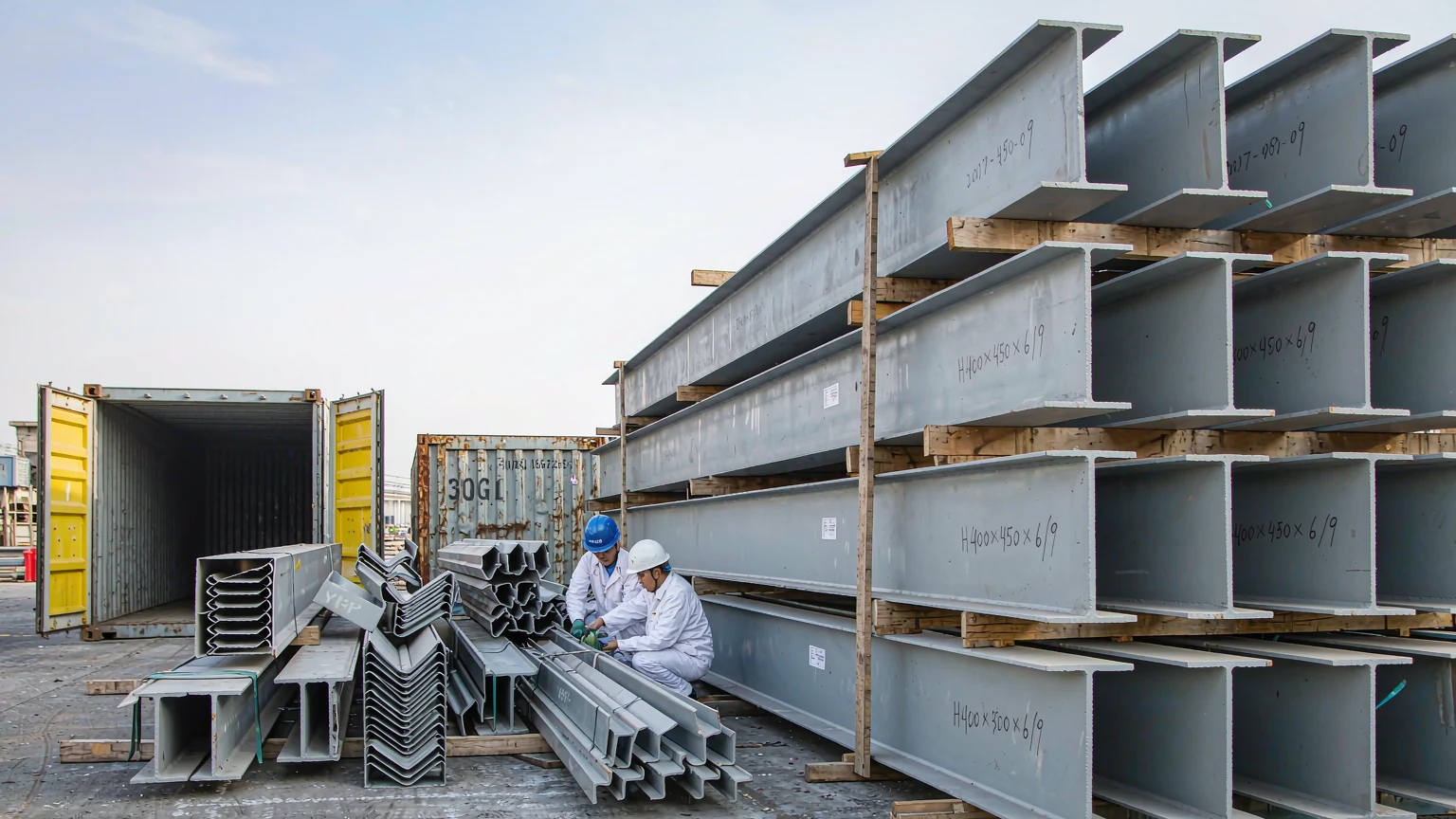
For coastal Moroccan sites, chloride loading drives the decision. We usually recommend AZ150 aluminium-zinc coating at 150 g/m². Inland sites with lower assessed corrosivity can run AZ100. Moreover, we pack coated components to prevent transit damage, because a damaged coating undoes the specification before erection starts.
Transparent Pricing and Delivery Terms (Check 6)
Compare quotes line by line, not total by total. A complete quote itemises fabricated steel tonnage, secondary framing, surface preparation and coating, packing, freight and installation guidance. By comparison, a lump sum hides which line carries the risk.
For reference, our 2026 Q3 export data prices a 15,000 m² warehouse at USD 1,575,000 CIF Casablanca. The breakdown: USD 1,500,000 of package cost plus 5% contingency. For example, you can review the full itemisation in our companion guide on prefabricated steel structures in Morocco.
Delivery terms need equal clarity. Under Incoterms 2020, CIF covers cost, insurance and freight to the named port (Incoterms 2020 rules). As importer of record, you handle customs clearance, duties and taxes. We supply the full document set, so clearance usually proceeds without surprises.
Erection Support and After-Sales Response (Check 7)
Delivery closes the supply contract; erection decides the project. For example, ask what arrives with the steel: lift plans, assembly sequencing, bolt torque schedules and quality checklists. Then ask who answers the phone during erection.
Our engineering team supplies lift plans and assembly sequencing, and support typically runs within two weeks of arrival. Reference projects show the range. A 75,000 m² long-span port transit warehouse in Tanzania and a stadium space frame roof in Algeria. Indeed, both sit in seismic or high-wind regions, and both shipped with documented erection support.
Sourcing Routes Compared
The table below compares three sourcing routes on documentation, programme and risk.
| Criterion | Certified export fabricator | Local fabrication | Fragmented multi-vendor |
|---|---|---|---|
| Execution documentation | EN 1090-2 EXC2 with certificate numbers | Varies by vendor; verify each | Each vendor separate; no single record |
| Seismic basis | RPS 2000 zone calculations included | Available; verify | Usually unverified |
| Lead-time predictability | Dated production plan and weekly reporting | Exposed to labour and material volatility | The weakest link governs |
| Commercial terms | Itemised CIF Casablanca quote | Lump sums common | Split responsibility |
| Single point of responsibility | Yes | Yes | No |
As can be seen in the table, documentation depth and single-point responsibility separate the three routes.
Conclusion
Price opens the conversation; documentation closes the deal. A steel fabricator Morocco buyers can verify beats a cheaper one they cannot. Therefore, run the seven checks, ask for numbers and records, and the shortlist shortens itself.
Submit your drawings and site details to the SynJect engineering team. We return a standards-compliant quotation and a free structural feasibility review within 24 hours. Finally, you can review our certificates and compliance page or our steel structure solutions before you enquire.
Standards referenced
- RPS 2000 — Règlement de Construction Parasismique, Ministry of National Territory Planning, Urban Planning, Housing and City Policy (Morocco)
- European Commission — Eurocodes: EN 1990 to EN 1999 structural design standards
- ICC — Incoterms 2020 rules
- SynJect — Credentials, quality and compliance (certificates)
- SynJect — 75,000 m² long-span port transit bulk warehouse, Tanzania
- SynJect — Stadium space frame roof, Algeria
- SynJect — Companion guide: prefabricated steel structures in Morocco
Frequently asked
Which certificates matter most when I evaluate a steel fabricator Morocco buyers recommend?
Start with EN 1090-2, because it governs execution: welding procedures, execution class and nondestructive testing. SynJect holds EN 1090-2 EXC2 under certificate 2787-CPR-01627. AWS D1.1 welding, ISO 3834 coordination, ISO 9001, ISO 14001, ISO 45001 and CE marking sit behind it. Management certificates support the system; however, they never replace the execution certificate.
Which seismic zone applies to my Moroccan site?
RPS 2000 (2011 version) assigns one of five zones. Peak ground accelerations run from 0.04g (Z0) to 0.18g (Z4). Send us the site location, and we confirm the zone and soil class with the calculation package. Where the structure falls outside RPS 2000 scope, we design to EN 1998.
How do I verify your NDT records?
Ask for a sample report from a completed project. Each report names the joint, the method (ultrasonic, magnetic particle or radiographic), the acceptance criteria and the inspector. We trace every report to a member mark, so your team can sample any weld.
What lead time should I plan for?
For a 15,000 m² warehouse, plan 12-14 weeks from order to completed assembly. The breakdown: six weeks for design and fabrication, three for coating and quality control, three for shipping and two for on-site assembly. Larger or longer-span structures scale from that basis. We confirm the dated window per project at enquiry stage.
What does CIF Casablanca cover?
Under Incoterms 2020, CIF covers cost, insurance and freight to the Port of Casablanca. As importer of record, you handle customs clearance, duties and taxes. We supply the complete document set, so clearance proceeds without surprises.
Do you provide on-site erection support?
Yes. We supply lift plans, assembly sequencing, bolt torque schedules and quality checklists. Support typically runs within two weeks of arrival. Our engineering team stays available through erection and handover.